On this page
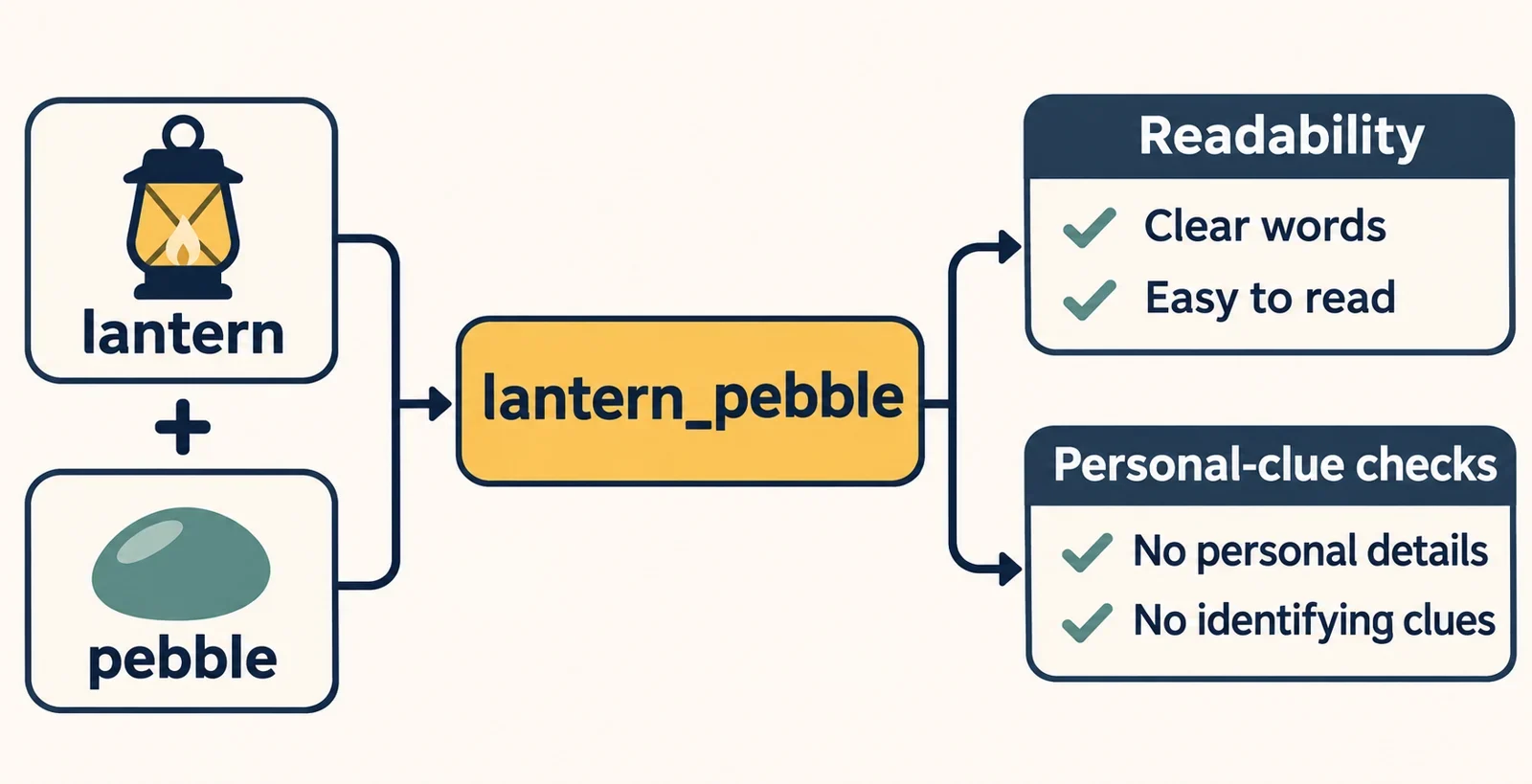
Choose a memorable username by combining words that do not identify you, testing how easily the result can be read and recalled, and checking it on the service where you plan to use it. First decide whether you want that account connected to your other accounts.
The goal is a small shortlist you can explain, spell and remember without relying on a name, birthday or familiar nickname. An invented example such as lantern_pebble shows the approach, but use it only if neither word has a recognizable personal connection for you.
Decide which accounts should connect
Start with the account’s purpose. For a public project, using the same username across sites can make you easier to find. For a community you want to keep apart from your other activities, choose a different handle. A distinctive username can connect accounts even when it contains no obvious personal detail.
Write down which accounts should form a group before choosing words. This makes reuse a deliberate choice instead of an automatic convenience.
| Your aim | Naming approach |
|---|---|
| Help people find related public accounts | Consider one consistent handle for that group. |
| Keep a community separate | Choose an unrelated handle for that community. |
| Still deciding | Keep several candidates until you decide what should connect. |
Ask yourself: if someone encountered this username elsewhere, would I want them to recognize the connection? Use that answer to guide the rest of the process.
Start with words that do not identify you
Make a small pool of words before combining anything. Start with ordinary objects, broad nature words or other everyday vocabulary, then screen each word against your own circumstances. Neutrality is personal: a word is a poor choice if people already associate it with you.
Leave out real names, initials, familiar nicknames, full birth dates, exact addresses, school names and personal numbers. Also remove words that point to your location or workplace. A hobby word deserves another look if it repeats an identity you are trying to keep separate.
For a practice pool, try ingredients such as lantern, pebble, ribbon and meadow. These are examples to evaluate, not automatically suitable choices.
Beside each word, ask: does this connect to a nickname, a place I mention often, an employer or an account I already use? Cross out anything that does. Keep enough words to try several pairings without having to add a personal detail when the first choice fails.
Turn neutral ingredients into a shortlist
Before using a username generator, read its descriptions of the inputs and outputs. If it offers an optional keyword, enter a word from your screened pool, or leave it blank if permitted. If separator and digit options are available, compare versions with and without them. Treat every returned suggestion as a candidate for further checks.
You can also combine the words yourself. The following invented examples show choices to compare. Evaluate each as a complete handle before adding it to your shortlist.
| Candidate | Decision to consider |
|---|---|
lanternpebble |
Can you spot both words immediately? |
lantern_pebble |
Does the separator help you read and share it? |
pebblelantern |
Does reversing the order make it easier to recall? |
An extra keyword or suffix adds length. Keep it only when it helps you distinguish or remember the result. Avoid long random-number strings and confusing mixtures of letters. If you try digits, exclude personal numbers and test the complete handle again.
Save three to five candidates as a manageable working shortlist. You do not need to keep every suggestion a generator returns.
Test readability and recall
Give each candidate three simple tests. Do these before choosing a favorite, so an appealing appearance does not decide everything.
- Say it aloud. Read the whole handle, including any separator or digits. Notice where you hesitate or need to explain the spelling.
- Try hearing and typing it. Ask someone to type it after hearing it, if you are comfortable sharing the candidate. Compare their attempt with your intended spelling.
- Take a short break. Put the list away, do something else, then try writing the candidates from memory.
Look at any mistakes for clues about what to change. Did two words run together? Was a character hard to distinguish? Did you remember the words but forget their order or the number at the end?
Keep a brief note beside each candidate: easy to say, easy to spell, easy to recall. Prefer the one that performs well across all three exercises over one that needs repeated explanations.
Check the whole handle for personal clues
Review the complete string after testing its individual parts. Read it as someone else might see it, including the order of the words, any shortened forms and the digits.
Use these questions for a final personal-clue check:
- Does any part reproduce your name, initials or a familiar nickname?
- Do the numbers correspond to a birth date, an address or another personal number?
- Do the words point toward a school, employer or location?
- Does the combination resemble a username already associated with you?
For example, adding a meaningful year to lantern_pebble may undo the reason you chose unrelated words. Replacing a word with your usual nickname creates a similar problem. Do not treat a separator as a solution to an identifying ingredient; reconsider the ingredient itself.
If you are unsure about a candidate, write down the possible connection. Compare it with another pairing from your pool. Choose the option that avoids the clue while remaining easy for you to remember.
Check the destination platform
Open the intended service’s username guidance before committing. Check its published rules for length, permitted characters and any relevant naming restrictions. If the service distinguishes between different kinds of account names, confirm which field your candidate will occupy.
Then use the service’s own availability check. A candidate on your shortlist is still only a proposal until you have checked it there. Do not assume that a spelling accepted by one service will satisfy another service’s requirements.
Search the exact candidate online as well, especially before using it widely. Review the results for associations with another identity or meanings you would rather avoid. Treat this as an additional review, separate from the destination service’s check.
Keep a short decision note for each finalist: requirements checked, availability checked, associations reviewed. If you change the spelling after any check, review the revised version too. The checks should apply to the handle you actually intend to use.
Adapt an unavailable name
When a candidate is unavailable, return to your word pool. Try replacing one neutral word, reversing the order or using a separator the destination service permits. Keep the change simple enough that you can still say and spell the result easily.
Work through a small sequence: lantern_pebble, then pebble_lantern, then ribbon_pebble. These invented variations demonstrate possible edits; check each one individually before choosing it.
Avoid solving the problem by adding your birth date, school abbreviation, workplace clue or a personal number. If you consider a digit suffix, ask what the number means to you before keeping it.
Run the revised candidate through the same readability, recall and personal-clue checks. Then check the service’s requirements and availability again. If a revision becomes awkward to explain, set it aside and try a new pairing. There is no need to preserve the first idea at any cost.
Keep separate identities separate
Before settling on a handle, compare it with the usernames you already use. Include recognizable variations, such as the same unusual word pairing with a different separator or suffix. If your aim is separation, choose a different combination rather than relying on a small cosmetic edit.
Reusing a distinctive handle can make accounts traceable across sites. That may support discovery for related public accounts, but it works against keeping communities apart. Choose unrelated usernames for the groups you decided to separate at the start.
Keep a private record of which username belongs to which service and which accounts you intend to connect. Refer to it when creating another account, so you do not reuse a handle out of habit.
Your final choice should pass three decisions: it suits your account connections, it contains no personal clue you recognize, and you can read, spell and recall it comfortably.